
A sticker can be a small part of your marketing, yet it often appears at an important moment. A customer opens a parcel, notices a shop display or receives a promotional pack, and your branding becomes part of that experience.
For a London business, those moments can happen in very different settings. An independent retailer might want branded packaging, a café may be planning a seasonal promotion, and an event organiser could need graphics that connect several campaign materials.
Choosing suitable vinyl stickers involves more than finding a design you like. The application surface, adhesive, artwork and intended period of use all influence the result. A sticker that works well on one material may perform differently on another.
This guide explains how to plan your project, prepare useful artwork and choose specifications around the way your stickers will actually be used.
Begin with the Job Your Sticker Needs to Do
Before choosing colours or writing a headline, decide what the sticker is meant to achieve.
Brand recognition, product information and promotional messaging are different purposes. Trying to achieve all three in a single crowded design can make the finished graphic difficult to understand.
For example, a parcel sticker might simply help a customer recognise your business. A promotional sticker could direct someone towards a campaign page. A display graphic may need to explain a specific offer.
Write the purpose in one sentence: “This sticker should help customers recognise our packaging,” or “This graphic should introduce our new service.”
That sentence gives you a practical way to assess later decisions. If an element does not support the purpose, consider whether it needs to be included.
Separate Essential Information from Optional Content
List the details that must appear, then place everything else in a second group.
Essential information might include your logo, a product identifier or a website address. An extended brand story, several social handles and multiple messages may be optional.
This exercise helps you create a readable layout before any artwork is produced.
What Makes Vinyl Different from a Paper Sticker?
Vinyl and paper are different material categories, and neither should be selected solely because of its name.
Vinyl products are commonly considered for applications where flexibility or resistance to handling and moisture may be relevant. However, the finished sticker’s performance depends on the complete specification, including its adhesive, printing process and protective finish.
Paper stickers can suit many packaging and promotional applications, particularly where the surface and environment do not require a different material.
Rather than assuming that vinyl is always the better choice, explain how the sticker will be used. Your printer can then discuss whether the available product matches those conditions.
The useful question is: “Will this specification work for my application?” That is more informative than asking whether one material is universally better.
Practical Uses for Stickers in a London Business
The strongest applications usually connect the sticker to an existing customer interaction. Instead of adding branding randomly, consider where it will be noticed and understood.
Packaging and Parcel Branding
A branded sticker can make suitable packaging feel more connected to your business.
It might carry your logo, a short thank-you message or an invitation to visit a relevant page. For businesses selling online, this can help connect the physical parcel with the website where the order began.
The packaging material still matters. Textured cardboard, coated boxes and flexible mailers may require different adhesive considerations. Share the actual surface details before confirming the product.
Promotional Packs and Events
Stickers can complement printed literature, welcome packs and campaign materials.
A business attending an exhibition might use a simple logo design alongside its brochure. A local event could include a campaign sticker that carries the same visual identity as its posters and online promotion.
Think about what happens after the recipient receives it. A useful or visually appealing design may have a clearer purpose than a graphic filled with information that is already available elsewhere.
Retail Displays and Customer Information
Printed graphics can support a product launch, highlight an offer or introduce a service within a suitable retail environment.
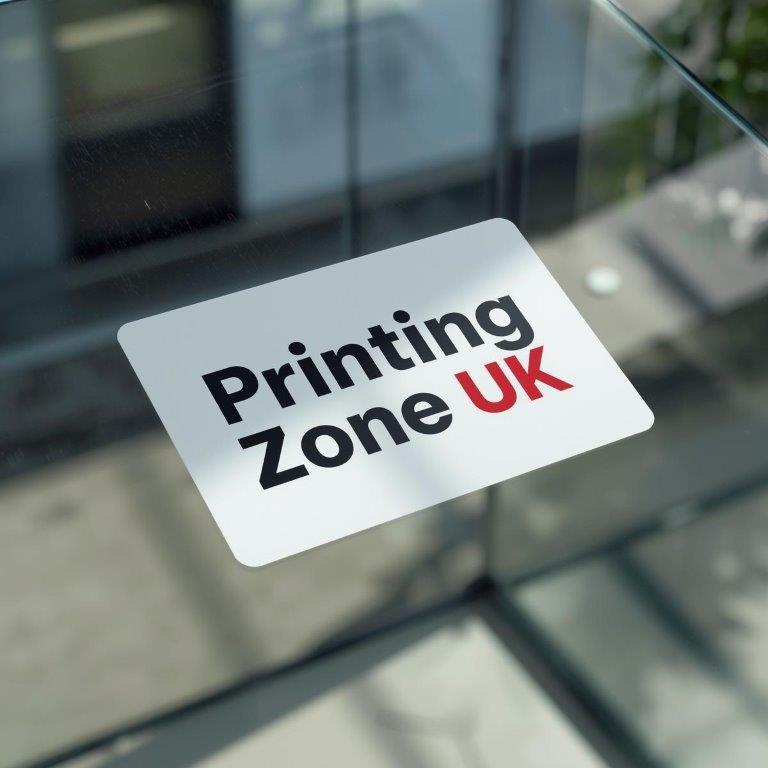
The application needs careful planning. A graphic for glass has different considerations from a sticker for packaging, and the available product must be suitable for the intended surface.
If the promotion will change, discuss removal requirements before ordering rather than treating removal as a problem to solve later.
Make London Relevance Useful to the Reader
A London-focused campaign does not need the city name repeated throughout the artwork.
Local relevance comes from understanding the audience and making the information useful. A campaign for a neighbourhood event should make the venue and date clear. A business promoting a service should explain what customers can expect and how to respond.
For a company with several London locations, artwork versions might differ by venue, contact information or campaign message.
Those differences should have a practical purpose. Replacing one area name with another without changing anything useful can create unnecessary versions and increase the chance of production errors.
Keep your branding consistent, and change only the information that genuinely needs to vary.
Check the Surface Before Selecting the Adhesive
The surface is one of the most important details to share with your printer.
“Packaging” or “a shop display” may not provide enough information. Explain whether the sticker will be applied to cardboard, glass, plastic, metal or a painted surface, and describe any coating or texture.
Even materials that appear similar can behave differently. A smooth finish may have different adhesion characteristics from a textured one.
Smooth and Textured Surfaces
Textured surfaces can reduce the contact available between the adhesive and the material beneath it.
A sticker that adheres well to smooth glass may not behave the same way on a rough surface. Confirm compatibility rather than transferring expectations from one application to another.
Cleanliness and Surface Condition
Dust, grease, moisture and residues can interfere with application.
Follow the product’s preparation guidance and make sure any cleaning method is suitable for the underlying surface. A cleaning product should not be assumed safe for every coating or finish.
Test When the Application Is Uncertain
Where the surface or conditions are unfamiliar, testing an appropriate sample can help identify problems before a wider application.
A test should reflect the actual use as closely as practical. Applying a sample to a different material may tell you little about how the final installation will behave.
Plan for Indoor or Outdoor Conditions
The words “indoor” and “outdoor” are useful starting points, but they do not describe every condition a sticker may face.
An indoor graphic might be exposed to regular cleaning, direct sunlight through glass or repeated handling. An outdoor application could encounter moisture, changing temperatures and surface contamination.
Explain these conditions when discussing the specification.
Avoid treating “vinyl” as a guarantee that every sticker will tolerate washing, weather or prolonged exposure. Those properties need to be checked against the selected product.
For a London campaign using several display locations, conditions may vary between sites. A sheltered installation and an exposed position should not automatically receive the same specification without review.
Think About Removal Before Applying the Sticker
A temporary promotion needs an exit plan.
Before ordering, explain whether the sticker is intended to remain in place or be removed after the campaign. The selected adhesive should reflect that requirement where an appropriate option is available.
Removal performance also depends on the surface, its condition, the period of application and the environment.
Permanent and Removable Applications
Descriptions such as “permanent” and “removable” should be understood in the context of the product guidance.
They do not mean that every surface will behave identically. A removable adhesive should not be treated as a universal promise of residue-free removal.
Protecting the Underlying Surface
Painted or delicate surfaces deserve particular attention. Check compatibility, obtain permission where relevant and follow the manufacturer’s application and removal instructions.
If the installation is uncertain, seek appropriate advice before proceeding.
Design Around a Clear Visual Hierarchy
A sticker should make its main message easy to find.
Start by deciding which element deserves the most attention. This could be the logo, the product name or a short promotional headline.
Supporting information should follow in a clear order. If everything is equally prominent, the viewer has to work harder to understand the design.
Give Each Element a Role
A logo identifies the brand. A headline communicates the message. A call to action explains what to do next.
Not every sticker needs all three. A simple packaging design may work with a logo alone, while a promotional graphic may need a destination or response method.
Use Space Deliberately
Empty space helps separate elements and improve readability.
Filling every available area can make the design feel crowded. Before reducing text to fit more content, consider removing information that does not support the main purpose.
Keep Contrast Strong
Important wording should remain clear against its background.
Avoid placing essential text over busy imagery unless the layout provides enough separation. Review the artwork as a complete design rather than judging individual elements in isolation.
Prepare Logo Files and Images Properly
Good source files give the printer a stronger starting point.
An original logo file is usually more useful than a screenshot taken from a website. Screenshots can contain unwanted backgrounds, compressed detail and edges that become less clear when reproduced.
Vector artwork is useful for logos and shapes because it can be adjusted without relying on a fixed grid of pixels. Photographs require suitable resolution for the intended print.
Ask for the preparation requirements before finalising the file.
Follow the Requested File Format
Use the format requested for the product and workflow. Do not assume that changing a filename extension converts the artwork correctly.
Check Fonts and Linked Images
Follow the supplied guidance for fonts and embedded images so the file can be reproduced as intended.
Keep an editable working copy for your own records, especially if the campaign may need revisions later.
Avoid Expecting an Exact Screen Match
Screen displays and printed materials reproduce colour differently.
Use the requested colour settings and discuss any important brand-colour requirements before production. A standard on-screen proof should not be treated as a guarantee of an exact physical colour match.
Allow for Cutting, Bleed and Safe Areas
The cutting edge is an important part of the artwork setup.
Bleed extends the background beyond the intended trim boundary. A safe area keeps essential text and graphics away from the cutting edge.
Follow the requirements provided for your order rather than applying a rule taken from an unrelated product.
For a design that follows a particular outline, confirm the available cutting options and how the artwork should be prepared.
Avoid placing a thin border close to the edge without discussing it first. Small production variations can become more noticeable when a design depends on perfectly even spacing around the perimeter.
Use QR Codes Only When They Help
A QR code can connect a physical sticker to digital information, but it needs a clear purpose.
It might link to product instructions, an event page or a relevant service page. Sending every visitor to a general homepage can create extra work for someone looking for specific information.
Test the Final Layout
Test the code within the completed artwork, not only as a separate image.
Contrast, surrounding space, print conditions and the application surface can all affect usability.
Explain the Destination
A short instruction such as “View the care guide” is more informative than an unexplained code.
Keep the Linked Page Useful
Make sure the destination works on a mobile device and remains relevant for the period the stickers will be used.
For important customer information, consider whether another readable contact or destination should also appear.
Organise Multiple Designs Before Production
Projects become easier to manage when each version has a clear identity.
If you need different graphics for products, venues or promotional messages, create a simple artwork schedule.
Record the design name, required quantity, intended application and delivery requirements. Match those names to the files you submit.
Avoid filenames such as “final-new-latest” that become confusing after several revisions. A consistent naming approach makes it easier to confirm which file has been approved.
For a London business operating across several premises, check whether each version contains the correct local information. A visually polished design can still be wrong if the contact details belong to another location.
Compare Sticker Orders on Equivalent Specifications
When comparing suppliers or exploring affordable options, make sure you understand what is included.
Two products described as “custom stickers” may differ in material, adhesive, finishing or artwork support.
A headline description alone does not tell you whether the product suits your packaging, display surface or campaign conditions.
Ask practical questions:
Is the material suitable for the intended application?
What should I know about adhesion and removal?
Which finishing and cutting options are included?
What artwork preparation is required?
How are separate designs handled?
What delivery arrangements are available?
This approach helps you judge suitability and overall value without relying on unsupported claims about which supplier is “best”.
Review the Proof as a Production Decision
Artwork approval should be treated as a careful review.
Check the design against the original brief. Does it communicate the intended message? Are the correct files, wording and brand elements present?
Look beyond the appearance of the layout.
Check Every Important Detail
Review spelling, website addresses, contact information, promotional dates and any version-specific content.
If several designs are included, approve them individually rather than assuming that one correct proof means all versions are correct.
Nominate a Final Approver
One person should be responsible for confirming the final artwork.
This helps avoid conflicting feedback and reduces the chance that an older version is approved accidentally.
Printing Zones UK provides an artwork proof for approval before printing. Use that opportunity to confirm the details before production proceeds.
Plan Delivery Around the Campaign
The date you want to begin using the stickers should influence the planning process.
Allow time to gather source files, prepare artwork, review proofs and resolve questions about the specification.
For a campaign involving several London locations, confirm whether the order needs to arrive at one central address or requires different arrangements. Discuss those requirements before finalising the order.
Printing Zones UK has a physical location in Manchester and offers UK-wide delivery, including London.
When exploring vinyl sticker printing for London businesses, provide the application details and delivery requirements together. That gives the team a clearer understanding of the complete project.
Apply and Store Stickers According to the Guidance
Correct application helps the selected product perform as intended.
Follow the instructions for surface preparation, handling and application conditions. Avoid improvising with heat, cleaning chemicals or tools unless the product guidance specifically supports their use.
If the stickers will be applied by several people, provide the same instructions to everyone involved.
Unused stock also needs suitable storage. Follow the recommended conditions and keep the material protected from contamination or damage.
For ongoing campaigns, identify older stock clearly so outdated promotional details are not used by mistake. Good organisation after delivery is part of maintaining a consistent customer experience.
Common Mistakes Worth Avoiding
Many sticker problems begin with missing information rather than poor artwork.
Ordering before identifying the surface can lead to the wrong adhesive choice. Preparing artwork before checking the cutting requirements may create extra revisions. Approving a proof too quickly can allow an incorrect website address to reach production.
Other avoidable mistakes include using a low-quality logo, adding too much text and assuming that all vinyl products have identical outdoor performance.
A short project brief can prevent much of this confusion. Include the purpose, surface, environment, artwork requirements and campaign timing.
The more clearly these points are defined, the easier it becomes to choose a suitable product and prepare a useful design.
Bring the Project Together Before Ordering
The most useful sticker is one that suits its purpose, adheres appropriately and communicates clearly.
Begin with the customer interaction you want to support. Confirm the surface and conditions, prepare focused artwork and review the proof carefully.
For a London business, that could mean more recognisable packaging, a clearer promotional message or a coordinated set of campaign graphics.
Share your artwork and application requirements with Printing Zones UK to discuss custom vinyl stickers, with support from our Manchester-based team and delivery across the UK.